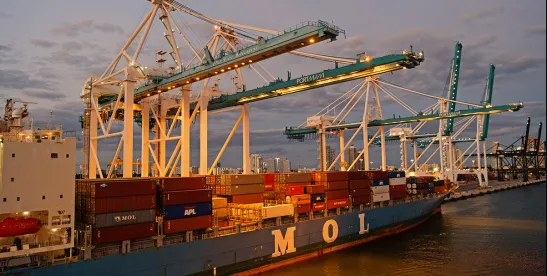
When a vessel arrives in a U.S. port, its owners, operators, and crew face a complex regulatory environment. The United States presents challenges for vessels because U.S. federal laws and regulations, and in some cases state-level requirements, are often different than laws and regulations applied in other jurisdictions around the world. In this regard, the United States has many regulatory requirements that go beyond what is contained in the international conventions applicable to international shipping. Understanding these U.S.-specific regulations requires careful preparation to help ensure strict compliance.
This article provides general guidance on what vessels must do when arriving at U.S. ports and offers practical advice for engaging with U.S. Customs and Border Protection (“CBP”), the U.S. Coast Guard (“USCG”), and other federal agencies.
Understanding the Regulatory Landscape
The USCG and CBP are the primary agencies responsible for enforcing laws applicable to foreign and domestic vessels calling at U.S. ports. The USCG enforces international conventions implemented by U.S. law and other U.S. laws under its Port State Control (“PSC”) authority. CBP enforces federal customs and immigration laws at U.S. ports of entry, as well as other requirements delegated to it by other federal agencies, such as the U.S. Department of Agriculture. Both agencies possess broad authority to board and inspect vessels, examine documents and cargo, and ensure compliance with applicable laws and regulations.
Under its PSC authority, the USCG conducts examinations of foreign-flag vessels arriving in a U.S. port or place, and enforces key international conventions within U.S. ports, including the International Convention for Safety of Life at Sea (“SOLAS”), the International Convention for the Prevention of Pollution from Ships (“MARPOL”), and the International Convention on Standards of Training Certification and Watchkeeping for Seafarers (“STCW”), among others. More generally, CBP officers and USCG PSC officers have broad law enforcement authority to conduct warrantless inspections and searches of foreign-flag vessels while in U.S. waters.
Pre-Arrival Requirements
Vessels bound for U.S. ports must complete notification and documentation requirements before arrival. Proper planning is essential to ensure a smooth entry process.
Notice of Arrival/Departure – 33 C.F.R. §§ 160.205-160.212. These regulations require that both U.S. and foreign-flag vessels file an electronic Notice of Arrival/Departure (“eNOAD”) when entering U.S. ports. The timing requirements are straightforward. If a vessel’s voyage time is 96 hours or more, an eNOAD must be submitted at least 96 hours before arrival at the port or place of destination. If the voyage time is less than 96 hours, the eNOAD must be submitted before departure but at least 24 hours before arrival.
Navigation Safety Regulations – 33 C.F.R. § 164. All vessels greater than 1600 gross tons, arriving and operating in U.S. ports, are subject to a series of regulatory requirements related to navigation safety equipment, testing, and reporting. For example, under 33 C.F.R. § 164.25, vessels are required to perform a series of operational tests and/or inspections before entering U.S. waters or prior to departure. These tests and inspections are generally required to be performed no more than 12 hours prior to arriving in U.S. waters and no more than 12 hours prior to getting underway. In practical terms this includes, among other things, testing and/or inspection of: primary and secondary steering gear; certain internal vessel control communications; standby or emergency generator; storage batteries for emergency lighting; and main propulsion machinery, ahead and astern.
There are also requirements for reporting any non-operational equipment under 33 C.F.R. § 164, such as radar and other essential bridge equipment. Additional operational requirements are set out in 33 C.F.R. § 164.11 for all vessels and 33 C.F.R. § 164.13 for tankers. To help ensure compliance, vessel owners and operators should review 33 C.F.R. § 164, in its entirety, to ensure its requirements are reflected in the vessel’s safety management system (“SMS”) and other operational procedures.
Marine Casualty and Hazardous Condition Reporting. Foreign-flag vessels operating in U.S. navigable waters (i.e., within 12 nautical miles from the U.S. coastline) must promptly notify the USCG of a reportable marine casualty, as defined in 46 C.F.R. § 4.05-1(a).[1]
Additionally, whenever a “hazardous condition” [2] is identified on board a vessel or is caused by a vessel or its operation, a report must immediately be made to the USCG. Of note, this requirement applies to all foreign-flag and U.S.-flag vessels that are bound for or departing from ports or places within the navigable waters of the United States.
Whether an occurrence or other situation qualifies as a reportable marine casualty and/or a hazardous condition is a fact-specific determination that depends on the nature and severity of the event, the vessel’s location, prevailing conditions, surrounding circumstances, and other relevant factors.
The USCG has issued guidance on marine casualty and hazardous condition reporting requirements in its Navigation and Vessel Inspection Circular 01-15, dated July 21, 2015. Since reports must generally be made “immediately,” incidents should be reported as soon as possible, along with identification of any necessary response actions being undertaken by the vessel to address the situation. Penalties can be significant for failure to report in a timely manner.
A prompt oral or written report to the USCG immediately following an incident typically fulfills the regulatory requirements for marine casualty and hazardous condition reporting. In the event of a reportable “marine casualty,” the regulation also mandates the submission of CG Form 2692 within five days, which provides the USCG with more detail on the incident.
Failure to report a marine casualty, as required by 46 C.F.R. § 4.05-1(a), can result in civil penalties for both individuals and corporate vessel owners and operators. Failure to report a “hazardous condition” under the Ports and Waterways Safety Act regulations, and violations of other regulations contained in 33 CFR Subchapter P, can result in both civil and criminal penalties. In recent years, the USCG and the U.S. Department of Justice have been aggressively enforcing, civilly and criminally, the failure to report a hazardous condition.
Cargo Declarations. Cargo declarations for containers destined for the United States must be submitted to CBP through its Automated Manifest System (“AMS”) at least 24 hours before loading in a foreign port. A container stow plan must be submitted no later than 48 hours after the vessel departs the last foreign port. Break bulk carriers are also subject to a pre-loading cargo declaration requirement but may apply to CBP for an exemption. Exempt break bulk carriers and carriers of bulk cargo must provide an electronic manifest 24 hours prior to the vessel’s arrival.
Crew Member Identification. The USCG requires crew members on foreign-flag vessels calling on U.S. ports to have at least one type of acceptable identification available to be presented on demand. Acceptable identification includes, for example, a passport or a Seafarer’s Identification Document that meets the requirements of the International Labour Organization Seafarers’ Identity Documents Convention (“ILO 185”). Other acceptable forms of identification are listed in 33 C.F.R. § 160.310.
What to Expect Upon Arrival in Port
USCG and CBP personnel routinely inspect vessels within U.S. ports. They may board a vessel at any time to conduct safety and security inspections. When a foreign-flag vessel arrives at a U.S. port, CBP will typically board the vessel to conduct an immigration and customs inspection. The primary focus of this inspection is to verify immigration documents of all crew members, screen individuals against relevant databases, and ensure compliance with applicable customs and immigration laws. CBP officers may also inspect the vessel’s stores and cargo declarations as part of their enforcement responsibilities.
Separately, the USCG may board a vessel to conduct a PSC inspection. The purpose of a USCG PSC inspection is to verify compliance with applicable international conventions and U.S. requirements with respect to vessel safety, security, and environmental protection. During a PSC inspection, the USCG examines the vessel’s key statutory certificates and performs an exam in accordance the International Maritime Organization (“IMO”) Resolution A.1185(33)(19), Procedures for Port State Control. The USCG has its own policies and procedures for Port State Control, including procedures and policies applicable to certain vessel types, which should be reviewed, considered, and understood by owners and operators of foreign-flag vessels calling on U.S. ports.
Practical Advice for Engaging with USCG and CBP Officials
Successfully navigating inspections requires thorough preparation and working in a collaborative manner with USCG and CBP officials. The following general guidance will help ensure positive interactions with USCG and CBP personnel.
Preparation is Essential. Vessel owners and operators must be well versed in the requirements applicable to their fleet and be proactive to ensure compliance, which includes documentation of training. All vessel documentation must be up to date and accurate. Checklists and other procedures should be considered and implemented to help facilitate compliance, particularly for requirements that may be less well known or specifically checked during routine inspections.
For example, CBP regulations require vessels to declare all cash on board in excess of $10,000, including cash provided to the master, on a FINCEN Form 105.
Because USCG and CBP personnel can inspect vessels within U.S. ports at any time, it is important that all information submitted to CBP and the USCG, and specifically that provided in the eNOAD, is accurate before it is submitted.
Verify Identity and Purpose of Visitors. When any government representative arrives at a vessel, it is essential to verify their identity and purpose for the visit, consistent with the Vessel Security Plan (“VSP”). The crew member on watch should request the inspector’s identification and carefully review it to confirm the individual’s name and the agency they represent. The visitor’s information must be recorded in the ship’s visitor log in accordance with the VSP.
Foster Effective Communication with CBP and USCG Officials. First impressions are crucial when interacting with CBP and USCG officials. In most cases, if there is a disagreement or miscommunication with USCG or CBP officials, those issues are properly resolved between the vessel’s Master and the officials onboard. If there appears to be a lack of communication or a disagreement with CBP or USCG officials that cannot be resolved, the Master should always remain professional and engage with shoreside management personnel to develop potential solutions and, possibly, elevate issues for resolution within the CBP or USCG. All crew should be professional and feel comfortable asking questions of such government officials, while ensuring they do not in any way interfere with or obstruct government inspections or other activities. In our experience, good-faith disagreements and miscommunications can be professionally resolved through constructive, senior-level dialogue with government officials.
Always Be Truthful. The vessel’s Master and crew members should always be truthful with CBP and USCG officials. If personnel choose to speak with investigators or inspectors, they must provide truthful information, as lying to a federal official constitutes a crime. Lying or obstructing during a routine inspection is considered a serious crime in the United States and will likely escalate a manageable situation into a criminal investigation, which could have serious ramifications for crew and the company.
Criminal Investigations. Criminal investigations onboard foreign-flag vessels have become more common in recent decades. Criminal investigations often start with a routine PSC exam but can evolve into a criminal investigation due to a whistleblower or deception on the part of the crew. If investigators or inspectors begin a criminal investigation, they are not required to disclose it to the Master or crew. In situations where it is not clear that a criminal investigation is underway, vessel crew may make incriminating statements unwittingly or otherwise.
Under U.S. law, all persons, including foreign crew members, have the right to speak or not speak with investigators, and the right to first consult with counsel. As outlined above, it is imperative that crew members be truthful if they choose to speak with an investigator.
If an investigation or inspection seems to be evolving into a criminal investigation, vessel owners and operators should have a plan to promptly engage with competent maritime criminal counsel for advice.
Rights Regarding Electronic Devices. CBP and USCG officers have broad warrantless search and seizure authority onboard vessels within U.S. jurisdiction, which includes searches of electronic devices such as personal cell phones and laptops. If CBP or USCG personnel determines there is reasonable suspicion of a violation of U.S. criminal law or there is a national security concern, they may conduct an advanced search without a search warrant.
An advanced search, without a search warrant, can involve copying the contents of electronic devices for later analysis. If CBP or USCG inspectors request consent to copy or view an electronic device, such as a crew member’s cell phone, the Master and/or crew member should consult with shoreside management and legal counsel before providing devices for advanced search or confiscation. Under no circumstances, however, should a crew member delete data, delete other information on the device, or obstruct the CBP or USCG’s investigation, even if they seize an electronic device or attempt to search it without consent.
Conclusion
There are several general principles to follow that are necessary to successfully navigate U.S. arrival procedures and inspections.
Essential starting points include developing a clear understanding of applicable regulatory requirements and maintaining effective communication between ship personnel, shoreside management, local vessel agents, and U.S. government officials. In addition, ensuring that vessel documentation is accurately maintained and interacting with CBP and USCG officials in a forthright matter helps build credibility and trust, which can facilitate more efficient port visits. Vessel owners and operators should also understand how USCG policies and procedures differ from those of other port state control authorities in other jurisdictions. Finally, vessel owners and operators should be aware that PSC inspections or marine casualties may, under some circumstances, evolve into civil or criminal investigations, and should understand the attendant risks such investigations may present.
Effective operational plans and procedures and comprehensive training programs to address the above requirements and risks are essential to ensuring compliance with applicable laws and regulations and facilitating smooth and seamless port visits in the United States.
[1] Marine casualty reporting requirements apply to U.S.-flag vessels wherever located. In addition, foreign-flag tank vessels must also report certain types of marine casualties when they occur outside of 12 nautical miles but within the U.S. exclusive economic zone (i.e., between 12 nm and 200 nm from the coastline) or other waters subject to U.S. jurisdiction, as set out in 46 C.F.R. § 4.05-2(b).
[2] A “hazardous condition” is defined as “any condition that may adversely affect the safety of any vessel, bridge, structure, or shore area or the environmental quality of any port, harbor, or navigable waterway of the United States. It may, but need not, involve collision, allision, fire, explosion, grounding, leaking, damage, cyber incident, injury or illness of a person aboard, or manning-shortage.” 33 C.F.R. § 160.202.